Gamstop uses 5th annual Self-Exclusion Day to target football fans as data reveals where self-exclusion is highest across the UK

22nd September 2026
• 10 football clubs supported Gamstop’s fifth annual Self-Exclusion Day helping take the self-exclusion message to more than 1.7 million football fans.
• Gamstop data reveals the ten areas with the highest proportion of residents registered for online self-exclusion.
• Registrations fell during England's World Cup matches before rebounding afterwards, highlighting the impact of major football events on gambling behaviour.
Clubs from all divisions in the English Football League backed Gamstop’s fifth annual Self-Exclusion Day campaign, helping raise awareness of self-exclusion among supporters across the UK.
Established in 2022, Self-Exclusion Day aims to raise awareness of Gamstop’s free self-exclusion service and encourages people concerned about their gambling to consider taking a break. This year's campaign saw clubs share content across Instagram and X to a combined audience of more than 1.7 million followers, generating 412 engagements across 16 posts. The participating clubs were AFC Wimbledon; Bolton Wanderers; Crewe Alexandra; Plymouth Argyle; Port Vale; Queens Park Rangers; The New Saints; New Saints Women; Tranmere Rovers; and Walsall. Gamstop data published to coincide with Self-Exclusion Day reveals the parts of the UK with the highest rates of self-exclusion registrations, providing a snapshot of where demand for gambling support is strongest.
The ten areas with the highest proportion of Gamstop registrations are:
1 Kingston upon Hull - 2.8%
2 North East Lincolnshire - 2.5%
3 Blackpool - 2.4%
4 Hartlepool - 2.3%
5 Middlesbrough - 2.1%
6 Derry City and Strabane - 2.1%
7 Doncaster - 2%
8 Redcar and Cleveland - 2%
9 Knowsley - 2%
10 South Tyneside - 1.9%
Gamstop data also sheds light on how major football tournaments can influence gambling-related behaviours. During this summer’s World Cup, registrations typically fell while England were playing, suggesting that people were less likely to take the decision to self-exclude during major matches. However, this was regularly followed by an increase in registrations afterwards, with spikes particularly apparent on the next working day.
The same pattern has been identified around previous major international tournaments. Registrations tend to fall on the day of major fixtures and finals before increasing afterwards, with the effect particularly pronounced around England matches.
The findings reinforce the importance of raising awareness of self-exclusion within football communities, particularly during periods when fan engagement is at its highest.
Matt Burgiss, Head of External Affairs at Gamstop said: “Our regional data shows that people are turning to self-exclusion in communities right across the country. It is particularly interesting to see many areas with strong footballing identities towards the top of the table.
We know that football and gambling remain closely connected for many fans, and our World Cup data shows just how clearly major matches can influence when people decide to self-exclude. Registrations tend to fall when England are playing before rising again afterwards, when some people may be reflecting on their gambling and deciding that they need to make a change.
That is why the support of football clubs on Self-Exclusion Day is so important. By taking this message directly to supporters, clubs can help make people aware that self-exclusion is available if gambling is becoming difficult to control.”
Latest posts
Gamstop reports 16% increase in self-exclusion registrations
Gamstop Online, the national self-exclusion scheme for online gambling, has reported a 16% year-on-year increase in registrations during the first half of 2026, with May setting a new monthly record. The biggest increase in registrations was among under 25s, a 26% year-on-year increase, and they now make up nearly one in three of all self-exclusions. Younger users are also most likely to opt for shorter exclusions, with 38% choosing the minimum six-month term, which indicates they are using it as a helpful preventative tool to manage their gambling. By contrast, more than one in two of the 614,738 consumers currently on Gamstop Online have opted for the maximum five-year exclusion and, amongst all age groups, only one in four have self-excluded for six months. Men accounted for more than seven out of ten new registrations, which is consistent with the gender split since Gamstop’s inception in 2018. Monthly registrations have been consistent throughout the first half of 2026, peaking in May with a record 12,236 sign-ups, but England’s successful World Cup run deep into the tournament could see that number eclipsed in July. Typically, Gamstop Online sees a surge in sign-ups immediately after a big football tournament, or after England have been knocked out. Matt Burgiss, head of external affairs at The Gamstop Group, who began betting on football as a teenager and subsequently experienced gambling addiction, warned: “There is a real risk that people have increased their gambling during the World Cup and once the tournament is over, they might turn to online casino games or other forms of gambling. Self-exclusion gives them the opportunity to take a break from gambling and prevent it from getting out of hand”. Fiona Palmer, CEO of The Gamstop Group, said: “The fact that self-exclusion has again increased significantly year-on-year shows that users are continuing to find it an invaluable and flexible tool to manage their gambling, particularly younger consumers. Whilst the landscape has changed significantly in recent months, our approach remains the same, which is to work collaboratively across the sector, emphasising the importance of layering tools and support, to enhance recovery for those experiencing harm”.
We are pleased to announce the appointments of Jo Costello and David Spruce as new Non‑Executive Directors and Matt Burgiss as our first Head of External Affairs
We are pleased to announce the appointments of Jo Costello and David Spruce as new Non‑Executive Directors, who will be joining the Gamstop Group at the beginning of June. Their combined expertise will continue to enhance the governance and strategic oversight of the organisation at an important time for the sector. Jo brings extensive experience across safeguarding, membership services and frontline support for vulnerable people, having worked across the third sector, education and social care. Her background in supporting individuals to regain stability and control, alongside her leadership at Rape Crisis England & Wales, will provide valuable insight as we continue to evolve our services. David brings more than three decades of senior financial and operational leadership, with experience across global organisations including Esso, Mars, JP Morgan, SunGard and QBE Insurance. He also holds significant governance roles across major charities and public bodies, contributing deep expertise in financial oversight, risk management and strategic planning. We are also delighted to welcome Matt Burgiss as our first Head of External Affairs. His highly respected expertise across both prevention and support, combined with his strong sector knowledge, lived experience and deep understanding of the benefits of using Gamstop, will significantly strengthen our external engagement strategy.
65% of university students have gambled in the past 12 months, rising to 75% among male students.
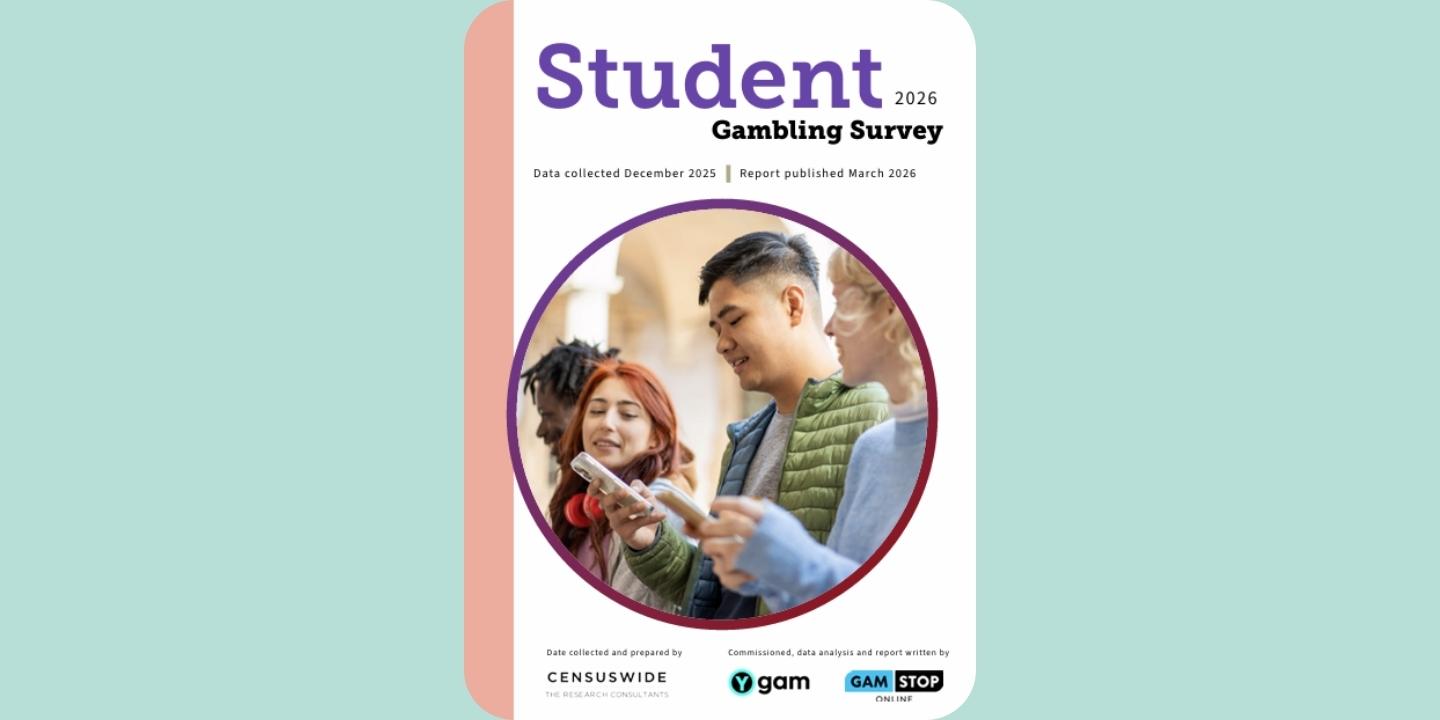
Today we’ve published the latest Annual Student Gambling Survey, now in its fifth year. Jointly commissioned with our partners [Ygam](https://ygam.org/), the survey gathers insights from 2,000 university students across the UK. Alongside this, we’ve published a five-year trend analysis, covering over 10,000 students, to understand how student gambling behaviour is evolving. Key findings: - 65% of university students have gambled in the past 12 months, rising to 75% among male students. - Average weekly gambling spend has almost doubled, from £27.24 to £50.33. - 34% of students who gamble say social media is a key influence. - 46% of student gamblers report that gambling has negatively affected their university experience. - Over the past five years, gambling among students has fallen from 78% to 65%, and the proportion experiencing harms has decreased from 24% to 18%. To read the press release and reports [click here](https://ygam.org/news/university-students-who-gamble-are-losing-an-average-of-53-a-week/) These findings show that students remain particularly vulnerable to gambling harms. By working with Ygam, universities and student unions can access training, tools, and resources to safeguard students and address gambling harms.

Gamstop attends the London Gambling Harms Conference and GamCare’s Parliamentary Reception 2026
Last week, our Chief Marketing Officer, Katie Reynolds-Jones attended both the London Gambling Harms Conference and GamCare’s Parliamentary Reception. These events provided valuable opportunities to meet colleagues from across the sector and engage in meaningful conversations about our shared commitment to reducing gambling harm. Thank you to Betknowmore UK and GamCare for inviting us to be part of these important discussions. The conversations throughout the week offered valuable insight and reaffirmed the importance of collaboration in strengthening protections for those most at risk.
